
Last updated September 10, 2026
Full 25-point door and opener safety check with every visit - springs, cables, rollers, tracks, and your LiftMaster or Chamberlain opener included
You get a price before we start. It does not change when the truck arrives.
 Before
 After
After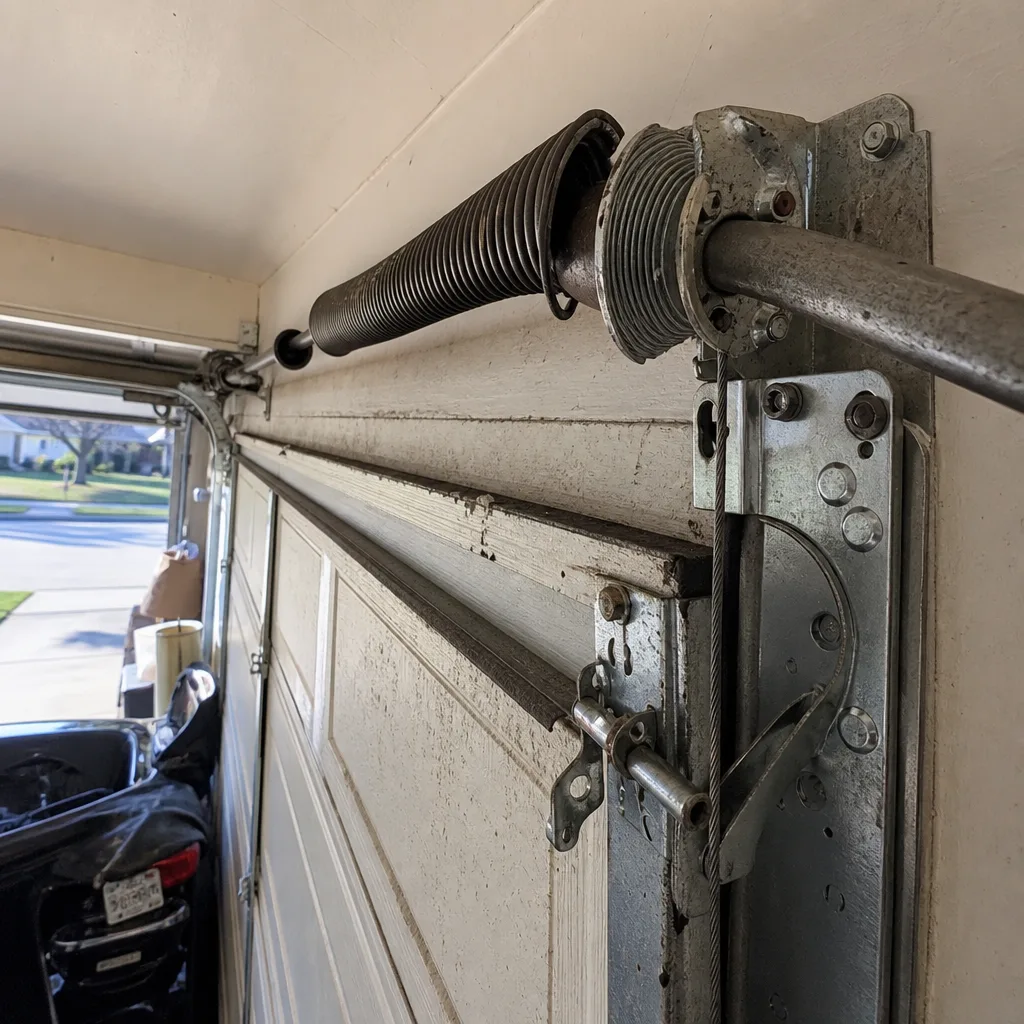 Before
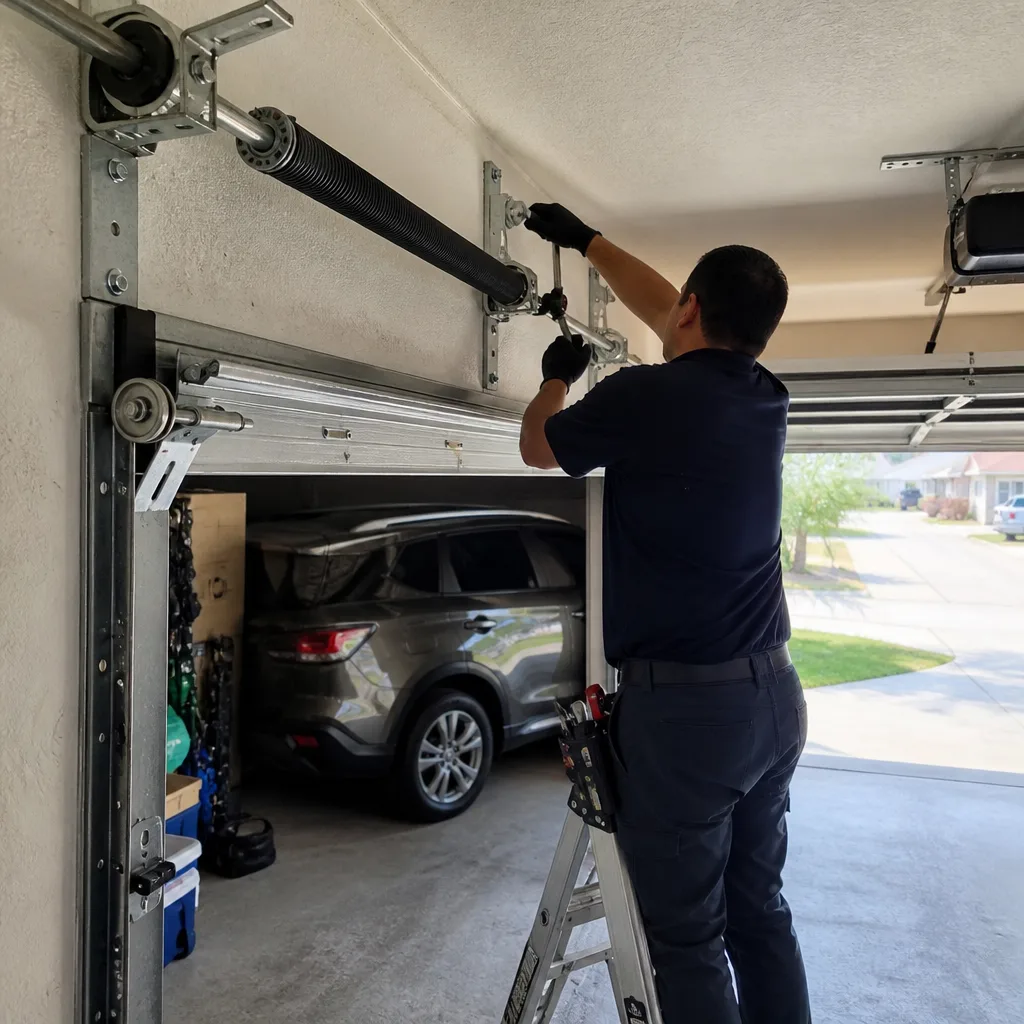 After
After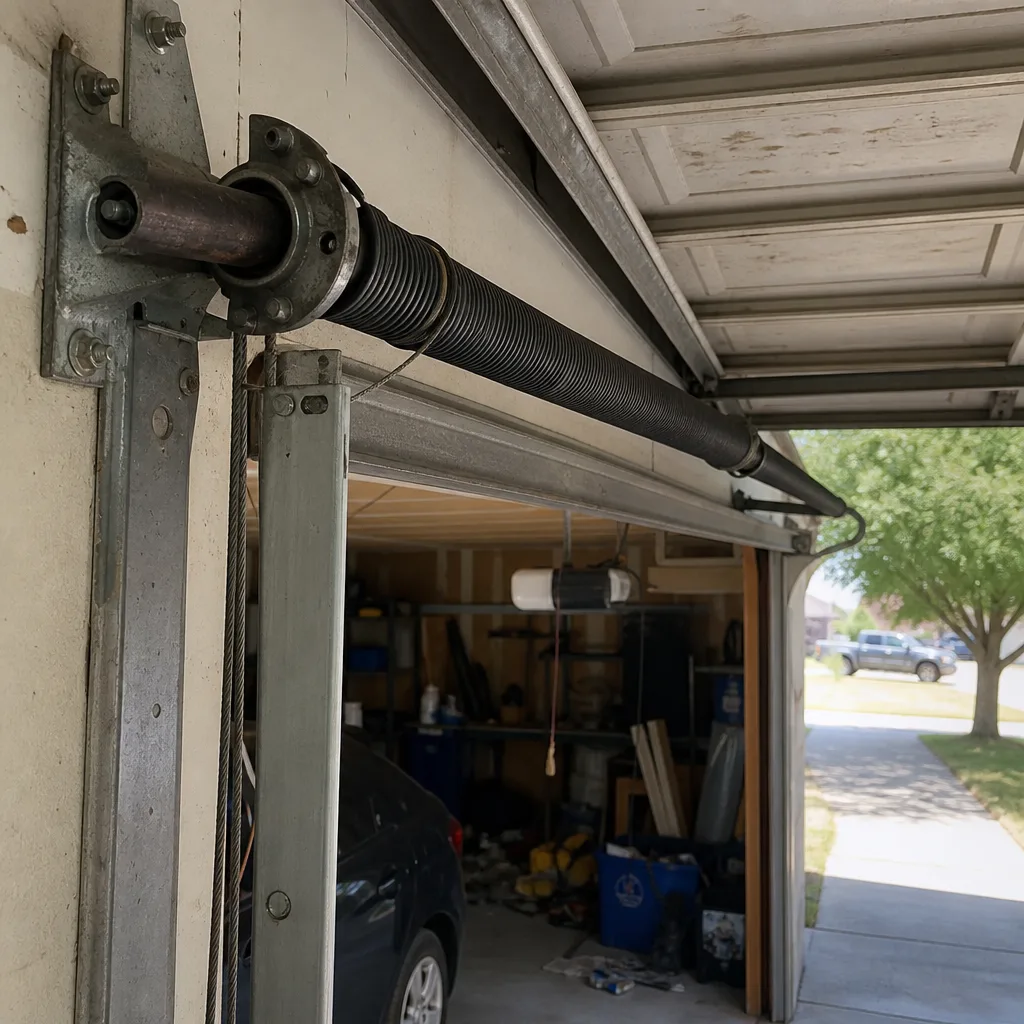 Before
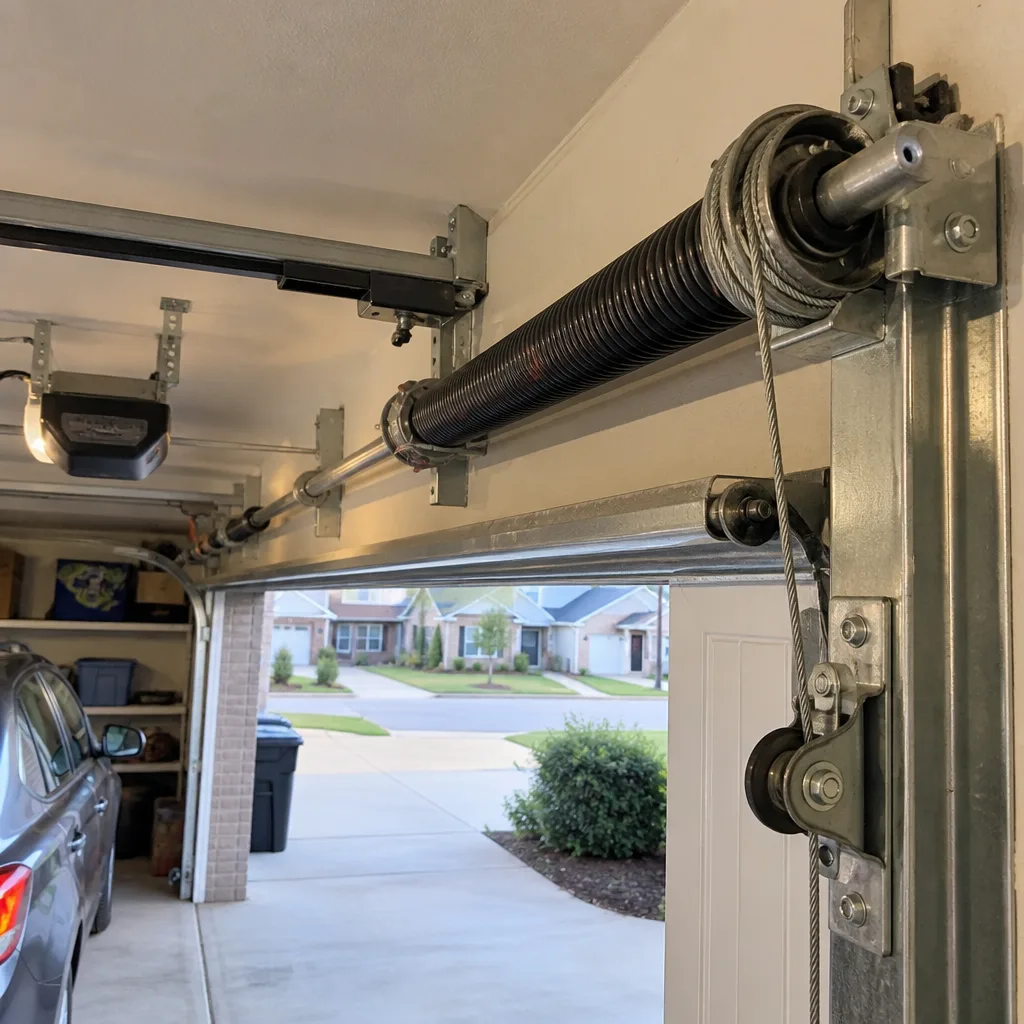 After
AfterHow to Hire a Garage Door Contractor in Fulshear: A Step-by-Step Guide
A contractor who quotes a garage door job without first measuring the rough opening and asking about header clearance is guessing, and that guess gets billed to you when the wrong door arrives. In Fulshear, where new construction and decades-old ranch homes sit side by side, we’ve seen homeowners pay twice for the same installation because the first crew skipped the basics. This guide gives you a short, repeatable vetting sequence so you can tell a legitimate local shop from a weekend operator before anyone steps in your driveway, and you can explore more guides & resources once you’ve finished.
Quick Answer
To hire a garage door contractor in Fulshear, verify Texas state licensing and general liability insurance, confirm parts come from recognized manufacturers like Clopay or LiftMaster, demand a written warranty with clear terms, and insist the price is quoted and agreed before work begins. Get at least two written estimates that itemize labor, materials, and haul-away, and avoid any contractor who pressures you for an immediate decision or offers a quote without measuring your opening.
Table of Contents
- Why Hiring in Fulshear Is Different From Houston or Katy
- The Four Questions to Ask Before Scheduling Any Estimate
- How to Read a Texas Contractor’s Certificate of Insurance
- Red Flags Specific to the Fulshear Market
- What a Legitimate Single-Visit Job Looks Like
- How to Compare Quotes When One Itemizes and One Doesn’t
- Common Mistakes to Avoid
- When to Call a Professional
- Frequently Asked Questions
- The Bottom Line
Why Hiring in Fulshear Is Different From Houston or Katy
Fulshear sits at a strange intersection of old and new. Cross Creek Ranch and Fulbrook on Fulshear Creek have homes built in the last fifteen years with 18-foot openings, hurricane-rated wind loads, and smart-home openers. Drive ten minutes to the original Fulshear townsite near FM 359 and FM 1093, and you’ll find ranch-style homes from the 1970s and 1980s with 7-foot single doors, uninsulated steel, and wooden frames that have settled with the clay soil.
This split personality matters when you hire a contractor. A crew that only knows new construction may not recognize the signs of a rotting jamb in an older home. A crew that only does quick repairs may not understand Fulshear’s wind-load requirements, which tightened after Hurricane Ike and again after Harvey. The city falls under Fort Bend County jurisdiction for unincorporated areas and has its own building department for newer developments, so permit requirements vary block by block.
The climate adds another layer, which is why we wrote our Seasonal Garage Door Care for Fulshear: Year-Round Homeowner’s Guide. Fulshear’s humidity swings from Gulf moisture in summer to dry northers in winter. That expansion and contraction wears on springs and cables faster than in drier climates. We’ve replaced springs in Cross Creek Ranch that failed in four years because the original installer used standard-cycle springs in a high-use household, ignoring the local conditions. A contractor who knows Fulshear accounts for this. One who doesn’t treats your door like it lives in Phoenix.
The market has also grown fast enough that legitimate local shops now share the phone book with operators who carry no insurance and source bargain parts from overseas suppliers. Fulshear’s population roughly tripled between 2010 and 2020, and that growth attracted crews who follow the construction, not the community. They’re here today, gone tomorrow, and good luck finding them when the spring they installed snaps in six months.
The Four Questions to Ask Before Scheduling Any Estimate
Every phone call to a garage door contractor should cover the same ground. Write the answers down. If a contractor hesitates or deflects, schedule someone else.
1. Are you licensed and insured in Texas?
Texas does not require a specific garage door license, but reputable contractors carry a general contractor registration or electrical license if they wire openers. Ask for the certificate of insurance directly. We’ll cover how to read it in the next section.
2. Where do you source your parts?
The answer should be specific: “We stock Clopay and Amarr doors, LiftMaster and Chamberlain openers, and we keep standard torsion springs and cables on the truck.” Vague answers like “we use quality parts” or “it depends on the job” often mean the cheapest option available that morning. Factory-authorized dealers have direct relationships with manufacturers and can obtain warranty support if something fails.
3. What does your warranty cover, and is it in writing?
Verbal warranties are worthless. A legitimate contractor hands you a document that states the duration, what components are covered, and whether labor is included. At Mainspring Garage Door Co. home, we put our 90-Day Done Right Promise in writing on every job: if it’s not right, we come back at no charge, no paperwork, no arguing. Some competitors offer “lifetime” spring warranties that exclude labor or require you to pay a service fee that equals the repair cost. Read the fine print.
4. Is the price quoted and agreed before work begins?
This is the question that separates professionals from predators. A flat price, stated upfront, with no surprises on the bill. If a contractor says “we’ll see when we get there” or “it depends on what we find,” you’re accepting an open-ended invoice. In our 42 years, we’ve learned that homeowners who have been burned by contractors remember one thing: the bill was bigger than the quote. We don’t let that happen. The price is the price.
How to Read a Texas Contractor’s Certificate of Insurance
General liability insurance matters on a garage door job because torsion springs store roughly 200 pounds of torque. When a spring breaks during installation or a cable snaps under load, the damage can be severe: broken car windows, dented sheetrock, personal injury. A contractor without adequate coverage leaves you paying through your homeowner’s policy, if it covers contractor negligence at all.
Request a certificate of insurance before anyone touches your door. Here’s what to check:
- Named insured matches the company. If the certificate shows “ABC Handyman Services” but the truck says “Elite Garage Doors,” that’s a red flag. Some operators lease another company’s insurance or work under a different legal name to hide claims history.
- General liability limit of at least $1 million per occurrence. This is standard for residential contractors in Texas. Lower limits suggest a new business, a history of claims that raised premiums, or a willingness to cut corners.
- Policy dates are current. Certificates expire. A contractor who hands you a certificate from last year may have let coverage lapse. Call the insurance broker listed on the certificate to verify active status.
- Your address is not the insured address. This sounds obvious, but we’ve seen certificates where the homeowner’s own policy was photocopied and presented as the contractor’s. The named insured should be the contracting business, not your household.
- Workers’ compensation is included or the contractor carries equivalent. Texas does not require workers’ comp, but if a technician is injured on your property and the contractor lacks coverage, your homeowner’s insurance may be tapped. Ask directly: “If your employee gets hurt on my driveway, whose policy pays?”
In Fulshear’s unincorporated areas, building inspectors sometimes spot-check insurance at the permit stage. In newer developments with HOA oversight, the association may require proof of insurance before work begins. A contractor who balks at providing documentation is not worth the risk.
Red Flags Specific to the Fulshear Market
Fast-growing suburbs attract a specific type of operator. Here’s what we’ve observed in Fulshear and surrounding Fort Bend County over the last decade.
Storm-chaser crews after weather events
After hailstorms or high-wind events, out-of-state crews descend with magnetic truck signs and temporary phone numbers. They knock on doors offering “free inspections” and find “damage” that requires immediate replacement. Fulshear sits far enough from the coast that hurricane damage is less common than in Galveston or Corpus Christi, but spring thunderstorms bring enough wind and hail to trigger these operations. Legitimate local contractors do not canvass neighborhoods after storms. If someone knocks uninvited, close the door and call a shop with a local address and history.
Door-to-door quotes without measurement
A garage door cannot be accurately priced from the sidewalk. The rough opening, header condition, track type, spring system, and opener horsepower all affect the final number. A contractor who offers a quote while standing in your driveway, without a tape measure or level, is either inflating the price to cover uncertainty or planning to add charges later. We’ve been called to jobs in Cross Creek Ranch where the homeowner was quoted $3,200 for a standard 16-foot replacement that should have cost half that. The original “contractor” never measured; he guessed high and hoped the homeowner wouldn’t compare.
Bait-and-switch spring pricing
This is the most common scam in garage door repair. A contractor advertises “$99 spring replacement,” arrives, and announces that your door requires “heavy-duty commercial-grade springs” at $400 each, or that both springs must be replaced when only one failed, or that the cables, rollers, and bearings are “worn beyond safe operation.” The $99 quote was never real. It was a hook.
Here’s the reality: most residential garage doors use two torsion springs. When one breaks, the second is typically near the end of its cycle life and should be replaced as a pair. A legitimate contractor explains this upfront, shows you the wear on the surviving spring, and quotes the pair price before touching anything. The bait-and-switch operator springs the price change after disassembly, when you can’t close your garage.
Pressure for immediate decisions
“I can do it right now for 20% off, but I need to start in the next hour.” This is a sales tactic, not a service offer. It prevents you from checking references, comparing quotes, or verifying insurance. A contractor confident in their pricing and quality does not need to pressure you. At Mainspring, we schedule estimates at your convenience and leave the written quote with you. The price doesn’t change if you call back next week.
No local address or verifiable history
Check the contractor’s address. A P.O. box or suite number in a shared office building may be legitimate, but a residential address or no address at all is suspicious. Search the Texas Secretary of State’s business filings. Look for reviews that mention specific Fulshear neighborhoods: Cross Creek Ranch, Fulbrook, Weston Lakes, Polo Ranch. Generic reviews (“great service, highly recommend”) with no location detail are often purchased. Specific reviews (“replaced our spring in Fulbrook same day, technician was on time”) are harder to fake.
What a Legitimate Single-Visit Job Looks Like
Most Garage Door Repair in Fulshear should be completed in one visit. If the contractor has to “order parts” for a standard spring, cable, or opener replacement, they may not be a serious operation. Here’s what a professional arrival-to-sign-off looks like.
Arrival and greeting
The technician arrives in a marked vehicle, wearing a uniform with a name badge. They introduce themselves, confirm the work described on the phone, and ask to see the door before unloading tools. Background checks are standard practice; if you’re uncomfortable, ask the company directly whether technicians are screened.
Inspection and explanation
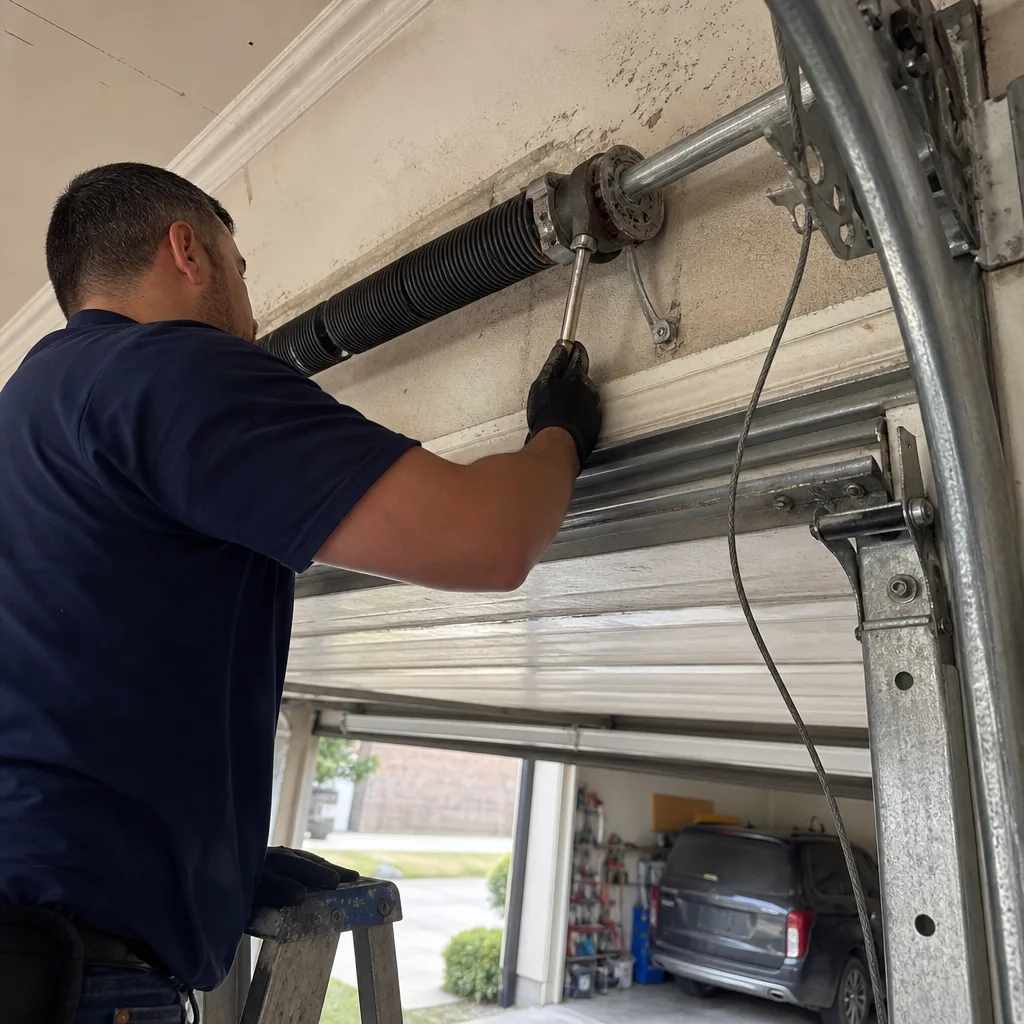
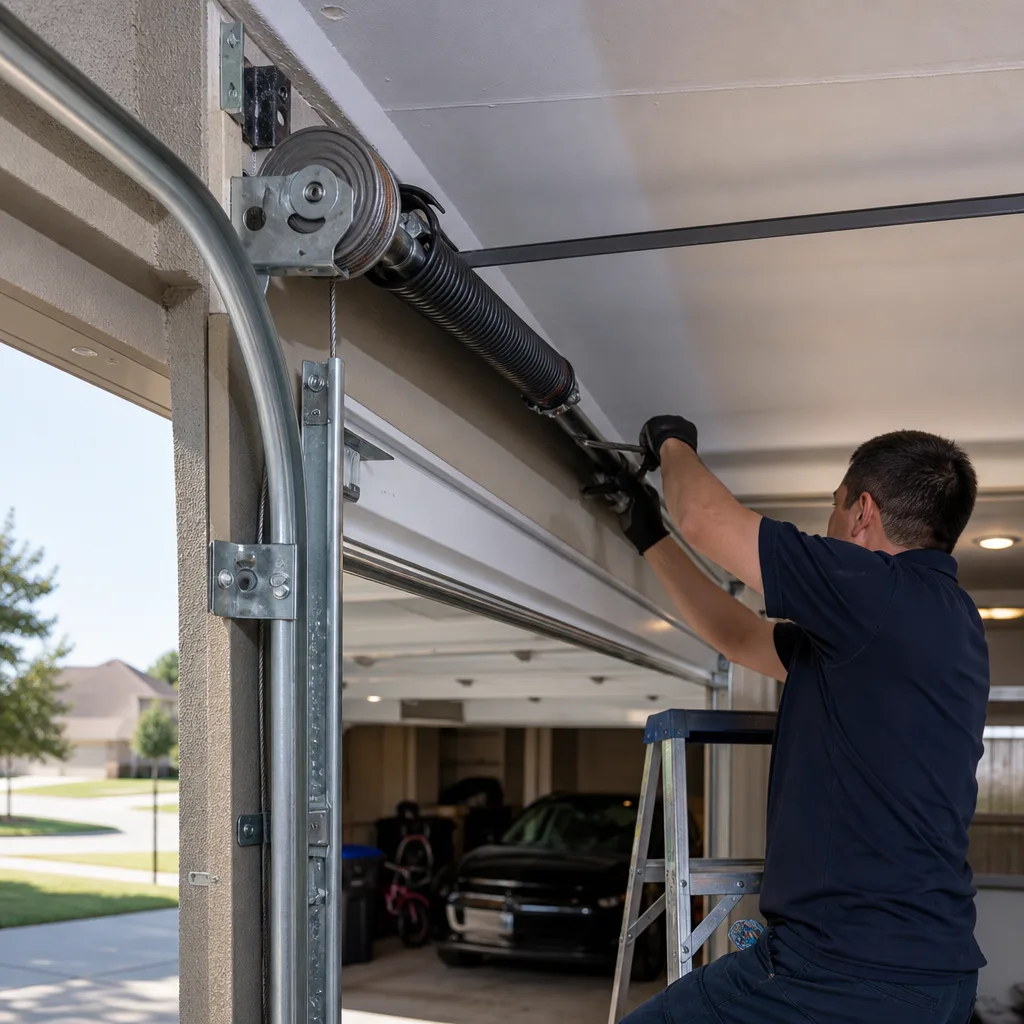
The technician inspects the entire system: springs, cables, rollers, hinges, tracks, opener, safety sensors, and weather seal. They explain what they find in plain language, not technical jargon designed to confuse. “Your left spring is broken and the right spring has about 2,000 cycles left, which is roughly six months at your usage rate. I recommend replacing both now. The cables show fraying and should be replaced with the springs. The rollers are original and worn; upgrading to nylon rollers will run quieter. Here’s the price for each option.”
Upfront pricing and authorization
Before any work begins, you receive a written quote with line items: parts, labor, tax, total. You sign or verbally authorize the specific scope. There is no “we’ll see how it goes” and no open-ended hourly rate. The price is fixed.
Execution and testing
The technician works efficiently, keeps the workspace clean, and tests the door multiple times: manual operation, opener operation, safety reverse, force settings, and photo-eye alignment. They show you the work, explain any maintenance you should do, and leave you with the written invoice and warranty document.
Sign-off
You inspect the work, confirm satisfaction, and receive a copy of everything in writing. The technician does not pressure for a review or payment method beyond what you arranged. The entire process for a standard spring replacement takes 60 to 90 minutes.
At Mainspring, our trucks carry standard torsion springs for 7-foot and 8-foot doors, extension spring sets, cables, rollers, hinges, weather seal, and replacement openers from LiftMaster and Chamberlain. We complete most Garage Door Repair in Fulshear in a single visit because we’ve already invested in the inventory. A contractor who arrives empty-handed and promises to “come back next week” has made their inventory problem your waiting problem.
How to Compare Quotes When One Itemizes and One Doesn’t
You call two contractors for a new door installation. The first sends a one-line email: “16×7 insulated steel door installed: $2,400.” The second provides a detailed breakdown: door model, R-value, window inserts, track type, spring cycle count, opener horsepower, labor, haul-away, tax. Which quote can you trust?
The lump-sum quote is a black box. You don’t know if you’re getting a Clopay Classic Collection with a 10,000-cycle spring or a no-name import with a 5,000-cycle spring that will fail in three years. You don’t know if the opener is a 1/2-horsepower builder-grade unit or a 3/4-horsepower belt-drive with battery backup. The price might be fair, or it might be inflated for inferior components.
Here’s how to level the comparison:
- Request itemization from the lump-sum contractor. If they refuse, that’s information. A contractor with nothing to hide breaks down the numbers.
- Compare door specifications, not just dimensions. Gauge of steel, insulation R-value, wind-load rating for Fulshear’s exposure zone, and window options. Two 16×7 doors can differ by $800 in material cost alone.
- Check spring cycle count. Standard springs are rated for 10,000 cycles. High-cycle springs last 25,000 to 50,000 cycles and cost more upfront but far less over time. A contractor who doesn’t mention cycle count is probably installing standard springs without asking about your usage.
- Verify opener brand and model. A LiftMaster 84501 with myQ and battery backup is not the same as a generic chain-drive unit. The installed opener should match what was quoted.
- Ask about haul-away and disposal. Removing an old door adds labor and dump fees. Some contractors bury this in the lump sum; others add it later. Clarify.
- Confirm warranty terms in writing. Door warranty, spring warranty, opener warranty, labor warranty. Different components, different durations, different coverage. A “lifetime warranty” on the door panel does not cover the springs.
For Garage Door Installation in Fulshear, we always provide itemized quotes because we want you to know exactly what you’re buying. We’ve seen too many homeowners in Weston Lakes and Polo Ranch discover, two years later, that their “great deal” used builder-grade springs in a high-use household. The door was fine. The springs were not. Itemization prevents that.
Common Mistakes to Avoid
- Hiring based on the lowest bid alone. In Fulshear’s competitive market, the low bid often excludes necessary components: proper wind-load rating for your exposure zone, high-cycle springs for daily use, or haul-away of the old door. The final invoice frequently exceeds a higher, more complete quote.
- Ignoring the spring cycle count. Homeowners focus on door style and opener features while the spring, which does the actual lifting, gets no attention. A 5,000-cycle spring in a three-car household fails in two to three years. Ask the cycle count and do the math.
- Accepting a verbal warranty. “Don’t worry, we’ll take care of you” is not a warranty. If it’s not in writing with specific terms, it does not exist. We’ve met homeowners who were told they had a “lifetime” spring warranty, only to learn it excluded labor and required a $150 “diagnostic fee” that equaled the repair cost.
- Not verifying local presence. A contractor with a Houston address may serve Fulshear, but will they return for warranty work? A contractor with no fixed address at all is a ghost. Check the physical location, drive by if possible, and confirm they’ve been in business under the same name for more than a few years.
- Scheduling installation without checking HOA requirements. Cross Creek Ranch, Fulbrook, and other Fulshear communities have architectural review committees with specific requirements for door style, color, and window placement. Install the wrong door and you’re paying twice: once for the installation, once for the replacement after the HOA violation notice.
- Attempting DIY spring replacement. Torsion springs are under extreme tension and require specialized winding bars and training. Every year, emergency rooms treat homeowners who tried to save $200 and ended up with lacerations, fractures, or worse. This is not a DIY project. The risk-reward math does not work.
- Not asking about opener compatibility. A new door with modern insulation and weight may overload an older 1/3-horsepower opener. If you’re replacing the door, have the opener evaluated. A contractor who doesn’t ask about your opener is not thinking about the complete system.
When to Call a Professional
Some garage door issues are maintenance items you can handle: lubricating hinges and rollers with silicone-based spray, clearing debris from photo-eye sensors, testing the manual release. Others require trained technicians with the right tools and safety knowledge, as we explain in our DIY vs Professional Garage Door: The Fulshear Homeowner’s Decision Guide.
Call a professional when: a spring is broken or visibly damaged; a cable has frayed or detached; the door is off its tracks; the opener runs but the door doesn’t move; there is visible damage to panels, especially after a vehicle impact; the door reverses unexpectedly or won’t stay closed; or you notice sagging, binding, or uneven movement. These symptoms indicate mechanical failure or safety system malfunction that poses injury risk.
For Garage Door Opener in Fulshear issues specifically, electrical troubleshooting and force-setting adjustments require both mechanical and electrical knowledge. Modern openers integrate with home automation systems and battery backup requirements, adding complexity beyond what most homeowners should attempt.
Mainspring Garage Door Co. offers free estimates in Fulshear. Call (409) 794-4141 to schedule a visit, or request a second opinion if you’ve received a written estimate elsewhere and want it reviewed. Our standing offers include $50 off any repair over $250, a $89 seasonal tune-up, and a permanent 5% discount for seniors and veterans.
Frequently Asked Questions
Most standard repairs in Fulshear range from $180 to $340 for spring replacement, $120 to $220 for cable or roller service, and $280 to $550 for opener repair or replacement, depending on horsepower and features. Full door replacement typically runs $1,200 to $2,800 for standard 16×7 insulated steel, with premium models and custom sizing higher. Call (409) 794-4141 for an exact quote; estimates are free.
Texas does not require a specific garage door contractor license, but reputable operators carry general liability insurance and often hold electrical licenses for opener wiring. Always request a certificate of insurance and verify the named insured matches the company you’re hiring. Unlicensed, uninsured operators are common in fast-growing markets like Fulshear.
Check for a verifiable local address, current insurance certificate, specific parts sourcing (named manufacturers like Clopay or LiftMaster), written warranty terms, and upfront pricing before work begins. Search reviews for mentions of specific Fulshear neighborhoods. Avoid door-to-door solicitors, storm-chaser crews, and anyone pressuring for an immediate decision.
Yes. Torsion springs are installed as balanced pairs and wear at similar rates. Replacing one spring while leaving a fatigued partner risks immediate failure of the older spring, damage to the opener, and an unbalanced door that strains the entire system. A professional technician shows you the wear on the surviving spring and explains the pair replacement before quoting.
A properly stocked service vehicle carries standard torsion and extension springs for 7-foot and 8-foot doors, cables, rollers, hinges, weather seal, and replacement openers from major brands. If a contractor must “order parts” for common repairs, they may lack inventory investment or be subcontracting through a third-party supplier. Ask before scheduling.
Request itemized quotes that specify door brand, model, steel gauge, insulation R-value, wind-load rating, spring cycle count, opener brand and horsepower, track type, labor, haul-away, and warranty terms for each component. Compare specifications, not just bottom-line price. A lump-sum quote without detail hides inferior components that cost more in early replacement.
The Bottom Line
Hiring a garage door contractor in Fulshear comes down to verification and patience, as detailed in The Complete Guide to Garage Door in Fulshear. Verify licensing, insurance, parts sourcing, and written warranties. Insist on upfront pricing before any work begins. Get itemized quotes you can compare specification by specification. Avoid pressure tactics, door-to-door solicitors, and anyone who won’t put promises in writing.
The Fulshear market offers plenty of choice, but choice without vetting is how homeowners pay twice. A legitimate contractor welcomes your questions, measures before quoting, stocks the parts for same-day completion, and stands behind the work with clear, written terms. That’s the standard we hold ourselves to at Mainspring, and it’s the standard you should demand from anyone working on your home.
Written by Carl Dutton, Owner at Mainspring Garage Door Co., serving Fulshear since 2016.